A customer walks into a shop with a blown speaker.
“I need better speakers. These don’t have enough bass.”
Seems simple enough.
Replace the speakers with something better. Maybe something with more power handling. Maybe
something that plays lower. Problem solved.
Except I don’t think we know what the problem is yet.
Why did the speaker fail? Was it being overdriven? Was there distortion? Is the factory system asking
that speaker to do something it shouldn’t? Was it simply a weak speaker?
And maybe more importantly: what was happening when it failed?
Was it 5:30 on a Friday after a terrible week at work, with the volume turned up because music is how
this person decompresses?
Or is it 5:30 in the morning on the way to the gym, with a playlist cranked because that’s how they put
their game face on for the day?
Those might sound like insignificant details.
To me, they’re not.
They’re the beginning of understanding what we’re actually trying to build.
Listening Before Designing.
One of the most important skills I’ve developed over the years has very little to do with installing
equipment.
It’s learning how to listen.
And I don’t mean simply hearing what someone says.
A client can tell me they want more bass, better speakers, a bigger amplifier, brighter headlights or a new
radio. Those are requests. They’re useful information, but they aren’t necessarily the objective.
“I want more bass.”
Okay. We can grab the biggest subwoofer that’ll fit and make a whole bunch of bass.
And let’s be clear – that sounds like a hell of a good time.
But we still haven’t figured out what the client actually wants.
My job is to figure out what’s underneath the request.
What are you actually trying to change?
What don’t you like about the vehicle now?
What do you wish happened when you turned that volume knob?
And perhaps most importantly: What does this experience do for you?
Sometimes people don’t have the vocabulary to describe what they’re hearing. Sometimes they know
exactly what they dislike but don’t know how to describe what they want instead.
And sometimes the answer is surprisingly personal.
Maybe you get in the car after a brutal day, put on Pink, turn it to 11 and sing like nobody is watching.
That’s useful information.
Actually, that’s really useful information.
Because now I’m not designing a system around a speaker specification.
I’m designing it around you.
Asking Better Questions.
There’s an art to asking questions.
Ask the wrong question and you can get a perfectly accurate answer that tells you almost nothing.
“What speakers do you want?”
“I don’t know. Good ones.”
Fair enough.
But if I can understand what you listen to, how loudly you listen, what you’re missing now, when you use
the system and what you want to feel when you use it, suddenly we’re speaking a completely different
language.
And not every client gets the same questions.
I’m listening to the words, but I’m also paying attention to how someone says them. Their inflection. Their
body language. What gets them excited. What they keep coming back to.
You can usually tell when you’ve reached the thing that actually matters.
That’s when the conversation changes.
There can be a little vulnerability involved in that. I’m asking someone to explain an experience that may
be very personal to them while they’re talking to someone who does this professionally and has an
entirely different technical vocabulary.
But they don’t need my vocabulary.
That’s my job.
They need to tell me what they want the experience to do.
Replacement Isn’t the Same as Improvement.
This is an important distinction.
Sometimes a broken part is just a broken part.
If you were perfectly happy with the way your system performed, a speaker failed, and all you want is to
get back what you had before, there’s nothing wrong with replacing it.
A capable DIYer can go online, buy the appropriate part and make that repair. I don’t discredit that at all.
But that’s parts replacement.
Experience isn’t in the business of simply changing parts.
If you’re coming to me because you want something better, now we have a different job to do.
Better how?
More output? More impact? Better clarity? Better staging? More control when the volume comes up?
Those answers matter because the equipment isn’t the experience. It’s what we use to create it.
I’ve always liked a kitchen analogy for this.
If you go to a great restaurant, you don’t need to walk into the kitchen and tell the chef which ingredients
to use, in what quantities, at what temperature and for how long.
You tell the chef what you’re looking for.
You don’t need to know where I got the beef.
Tell me what kind of meal you came for.
Tell me what you like, what you don’t, and what you want the experience to be when it’s sitting in front of
you.
Then let the chef cook.
Because ultimately, the equipment isn’t the product I’m trying to deliver.
The experience is.
When “More Volume” Doesn’t Mean More Volume.
I had a client come to me with a brand-new Ram equipped with the Harman Kardon factory audio system.
His complaint was straightforward:
It wasn’t loud enough.
So we talked for a little bit, and eventually I said, “Let’s go listen to it.”
We got in the truck and turned it up.
And the thing was unbelievably loud for a factory audio system.
To the point that I was almost confused.
If I had simply taken his original request literally, I would have designed a system around output: more
amplifier power, more capable speakers, more volume.
Except volume wasn’t actually his problem.
When we pushed the system hard, everything started coming unwound.
The separation disappeared. The sound blurred together. Distortion increased. The system stopped
sounding controlled.
He didn’t need it to simply get louder.
He needed it to hold itself together when it got loud.
That’s a completely different problem.
I tend to describe it like an engine sitting on the rev limiter.
You can keep your foot buried in it, but you’re no longer getting meaningful performance. You’re just
beating against the limit.
The answer isn’t necessarily another thousand RPM.
Sometimes the answer is getting off the limiter and back into a range where the system can actually
perform.
That realization changed the architecture of the entire project.
We went from thinking primarily about power to thinking about control and adjustability.
Two very different paths – all because we figured out what the client actually meant by “louder.”
We Don’t All Want the Same Thing.
That’s why I don’t believe there is one universally “better” audio system.
Some people like sweet. Some like salty. Some want savory.
Audio isn’t much different.
One person may want incredible detail and a believable soundstage. Another wants impact. Another
wants to feel the kick drum hit them in the chest. Someone else wants to drive with the windows down
and still have enough output to make the experience exciting.
None of those people necessarily needs the same system.
Even if they’re driving the exact same vehicle.
It’s also why I struggle with designing systems exclusively around products.
As I’ve said before, a $1,000 set of speakers isn’t automatically better for someone because it costs
$1,000.
A giant subwoofer isn’t automatically the answer because someone asked for more bass.
A DSP isn’t valuable simply because it’s a DSP.
Every component is a tool.
The system is the result.
And the result has to be designed around the person sitting in the seat.
Then I Have to Listen Again.
Eventually the conversation stops.
The vehicle is in the shop. The equipment is installed. The fabrication is finished.
Now listening takes on an entirely different meaning.
Now I have to listen to the vehicle.
This side of listening is different because subjectivity starts running into physics.
There are things we can prefer, and then there are things that are simply happening.
A speaker can be out of phase. A crossover can be inappropriate. A driver can be reaching its
mechanical limits. A factory signal can be altered in ways that fundamentally change what an aftermarket
system is being asked to reproduce.
The system can be loud as hell and still be falling apart.
Those aren’t matters of taste.
They’re technical conditions.
We have measurement tools to identify them, and I believe strongly in using them. Measurement gives us
information our ears alone can’t always provide.
But measurement isn’t the finish line either.
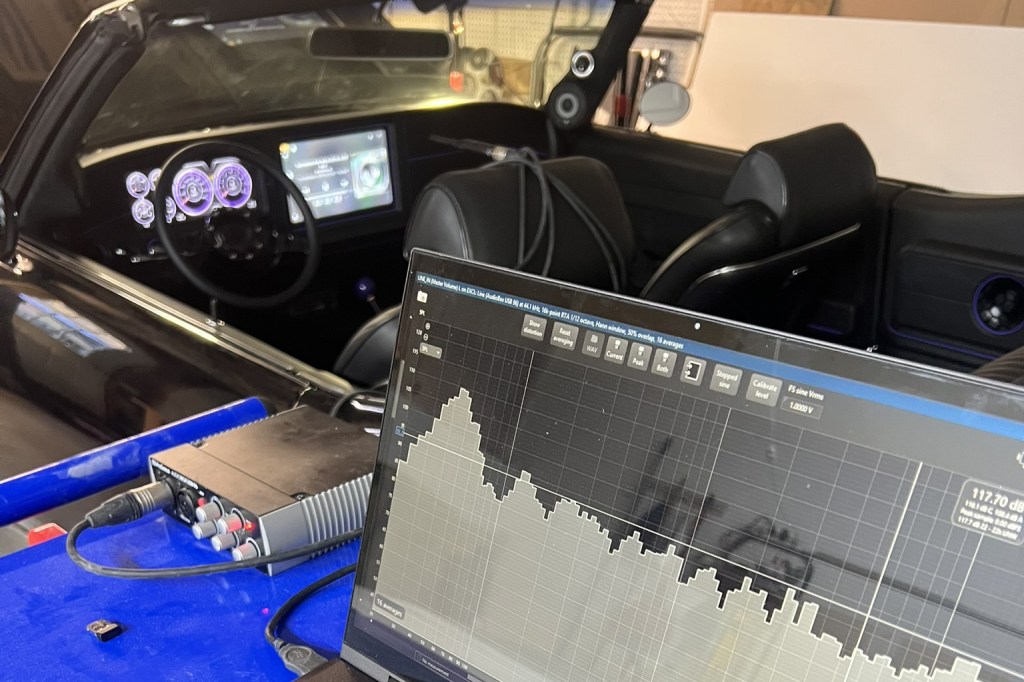
At some point I still sit in the driver’s seat.
And I listen.
Does the image exist where it’s supposed to?
Does the stage have depth?
Does a vocal sound believable?
Does the low-frequency energy integrate with the rest of the system, or does it simply sound like there’s a
subwoofer somewhere behind me?
And when I turn it up, does the system stay composed – or do I find that rev limiter again?
Most importantly: Does it create the experience we talked about before I ever touched the
vehicle?
And that’s not a question I only ask myself.
When the client gets back into the vehicle, we have another conversation. In a lot of ways, I’m asking the
same questions I asked in the beginning – but now we have something tangible to compare them against.
Did we accomplish what we set out to accomplish?
Does the system behave the way you wanted it to?
Does it give you what you were missing before?
At the beginning of the project, those questions help establish the target. At the end, they help validate
that we actually hit it.
Because ultimately, my interpretation of what the client wanted isn’t enough. The finished vehicle has to
deliver on the expectation we established together.
We listen in the beginning to define the experience. We listen again at the end to make sure we
delivered it.
There Is Right, Wrong – and Preference
Not everything in audio is subjective.
There are right and wrong ways to integrate equipment. There are electrical limits, acoustic relationships
and signal problems. There are installation practices that either allow a component to perform or prevent
it from doing so.
We can measure those things. We can diagnose them. We can fix them.
But once those fundamentals are correct, there’s an enormous landscape of preference.
That’s where the client belongs in the process.
And the conversation that started the project works much the same way.
There are questions worth asking and questions that simply aren’t relevant. There are assumptions that
move us closer to the objective and assumptions that can send an entire project in the wrong direction.
The skill isn’t memorizing a predetermined list of twenty qualifying questions.
It’s knowing which question to ask next.
Listen.
Ask.
Listen again.
Understand what the answer actually means.
Then use the technical knowledge to translate that answer into something tangible.
The Art of Listening
I’ve talked before about what I call “the art of installation.”
To me, the “art” isn’t the absence of science, measurement or technical discipline.
It’s what happens when you understand those things well enough to use them in service of something
human.
Listening works the same way.
I listen to the client so I can understand the experience we’re trying to create.
I listen to the vehicle so I can understand what it’s actually doing.
I measure so I can separate problems from preferences.
And then I use all of that information to design the solution.
That’s the difference between changing parts and creating an experience.
You don’t need to know every ingredient.
You don’t need to know the recipe.
Just tell me what kind of meal you came for.
I’ll take it from there.
Scott Miller
Owner / Integration Specialist
Experience Auto
